Branch office
Magsimula sa access switching, PoE budget para sa telepono at access points, WiFi coverage at security gateway. Maaaring pumili ng EX switches, Mist access points at SRX firewalls ayon sa mga ito.

Mga industriyang pinaglilingkuran
Ikonekta ang mga tao, application at opisina gamit ang praktikal na plano ng kagamitan. Pagsamahin ang switching, WiFi, security at server compute, kasama ang mga lokal na engineer para sa configuration at suporta.
Magsimula sa access switching, PoE budget para sa telepono at access points, WiFi coverage at security gateway. Maaaring pumili ng EX switches, Mist access points at SRX firewalls ayon sa mga ito.
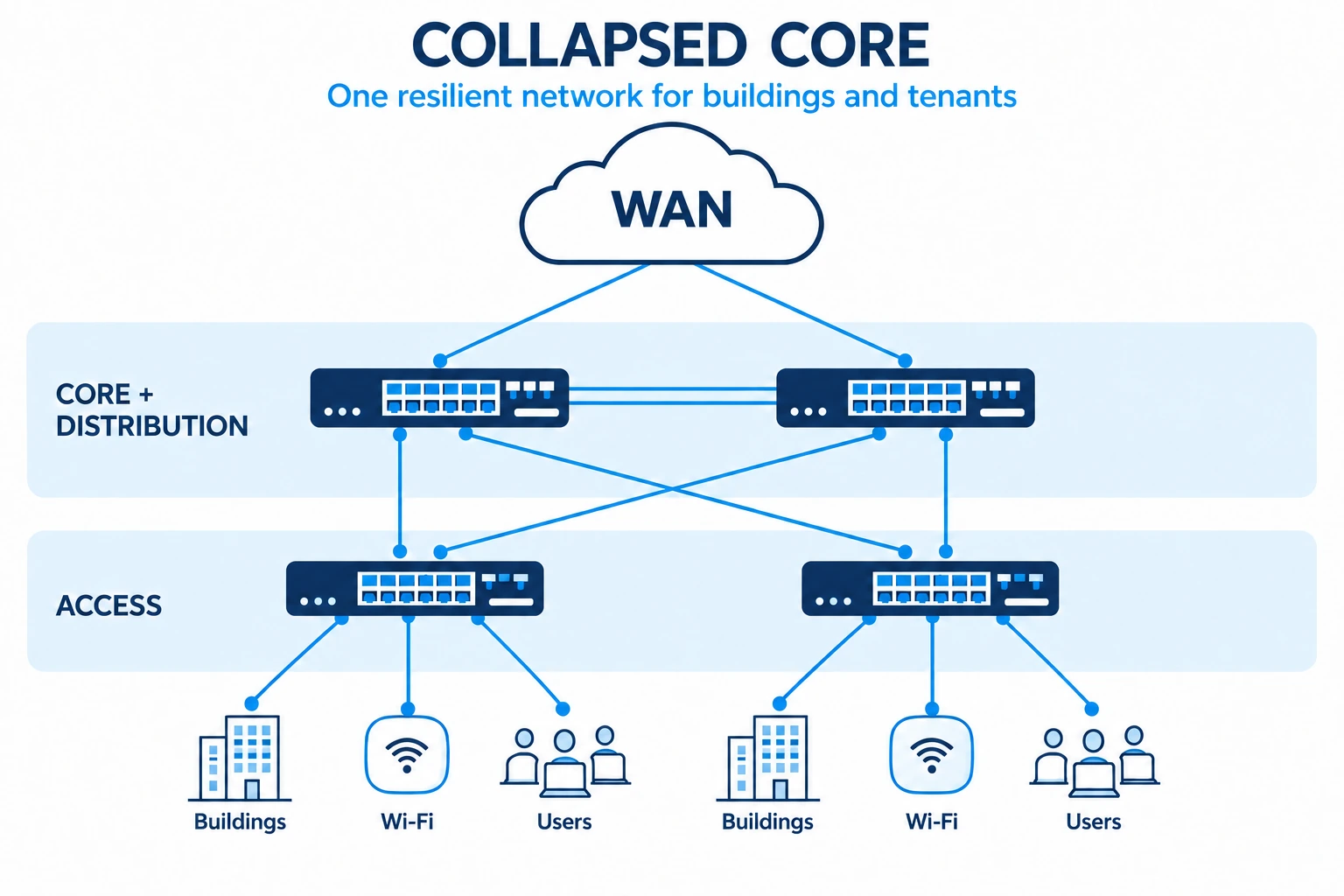
Pinapadali ng redundant collapsed core ang pamamahala ng mas maliit na campus. Maaaring mas angkop ang fabric sa malalaking deployment. Planuhin ang floor uplinks, voice traffic, dami ng client at paghihiwalay ng mga departamento o customer.
Ikonekta ang mga branch gamit ang routed WAN links o secure VPNs at pare-parehong access policies. Itugma ang Dell server compute at storage sa business applications, virtualization at backup.
Binibigyan ng QoS ng angkop na prayoridad ang mahalagang traffic kapag congested ang network. Itakda ang application classes at bandwidth limits, at subukan ang voice at video sa makatotohanang load.
Ibase ang coverage sa sabay-sabay na clients, hindi lamang sa lawak ng lugar. Sabay na suriin ang puwesto ng access point, roaming, switch power budgets at uplink capacity.
Ihiwalay sa angkop na network segments ang guest, staff, voice at sensitibong application traffic. Itakda ang firewall policies at remote-access requirements bago ang deployment.
Pumili ng redundant uplinks at power kung kailangan. Maaaring gawing mas simple ng stacking o Virtual Chassis ang pamamahala sa suportadong models; subukan ang failure behavior at idokumento ang recovery steps.
Technical buying guide · English
Campus networks are primarily about forwarding capacity, power delivery, wireless airtime and resilience. Buying more switch CPU or RAM is rarely the first answer to slow user traffic. Specify access ports, uplinks, security services and operational scale against the users and applications the network must support.
1IX editorial · Sources checked
Access speeds, aggregate uplinks, oversubscription and queues.
Endpoint power, AP uplinks, concurrent clients and airtime.
Failure paths, routing tables, segmentation and management.
Oversubscription is the nominal downstream capacity divided by available upstream capacity. For 48 × 1 Gb/s access ports and a 10 Gb/s uplink it is 4.8:1. That ratio is a planning indicator, not a prediction of congestion: actual simultaneous traffic matters. Check utilization and queue drops during busy periods. QoS (quality of service) can prioritize voice during contention but cannot create additional bandwidth.
Sizing visual · Calculated example
Nominal aggregate capacity · Gb/s · all normal-state members active
A redundant uplink pair loses half its nominal capacity when one equal-speed member fails.
Calculated by 1IX for active/active equal-speed members. Actual forwarding depends on topology, link aggregation, hashing and overhead. A single flow generally uses one member link. These are capacity scenarios, not switch benchmark results.
An aggregation group can spread multiple flows across links, but a single flow is generally limited by the member link selected by the hashing policy. Recalculate capacity after a link failure. Two active 10 Gb/s uplinks offer 20 Gb/s nominal aggregate capacity; if one fails, the remaining path is 10 Gb/s. Redundancy needs an explicit capacity and convergence test, not just a second cable.
PoE means power over Ethernet. Count phones, cameras and access points and check their supported power classes, startup demands and cabling. Juniper’s guide lists different switch-wide budgets by model and power-supply configuration. A per-port maximum does not mean every port can deliver that maximum simultaneously. Also check the available budget after a power-supply failure. Wireless planning must cover concurrent clients, airtime, interference and roaming, rather than floor area alone.
Sources: Juniper: PoE user guide and model-specific power-budget tables
Sizing visual · Source-backed model
EX2300-24P: 370 W switch-wide PoE budget · hypothetical allocated loads
Dashed marker: 370 W budget
Port count and per-port PoE support do not establish the total available power.
Juniper lists a 370 W maximum PoE budget for EX2300-24P. Loads above are 1IX arithmetic examples using assumed switch-side power allocations per port, not measured device draw or power delivered at the endpoint. Account for negotiation, cable losses, startup requirements and reserve. Excess demand cannot be supplied simultaneously.
Juniper PoE guide: EX2300 maximum power-budget table ↗Switching ASICs handle the data path; the control-plane CPU and memory handle tasks such as routing protocols and management. Check forwarding and packet-rate specifications alongside MAC/ARP/route scale and the enabled security features. A collapsed core can be appropriate for a smaller campus. EVPN-VXLAN separates an IP underlay from an overlay for segmentation; Juniper’s validated design describes BGP, ECMP (equal-cost multipath) and BFD (failure detection) as parts of a resilient fabric. The operational complexity must fit the team.
Sources: Juniper Validated Design: campus fabric core-distribution ERB
Aggregate uplink Gb/s · access capacity = 48 Gb/s
Select EX equipment by supported port speeds, PoE budget, uplinks and software features. Dell server generation is not a campus-switch classification.
Evaluate supported EX or QFX roles against traffic, route scale, optics and resilience. A fabric is a design choice, not a requirement for every office.
When Dell 14G, 15G or 16G servers attach to the campus, check NIC speeds, transceivers and upstream capacity. A newer server does not remove a congested network path.
Share your measurements and growth plan. Ask us to separate equipment pricing from configuration, migration, deployment, support and warranty options, with stock, lead times and service scope confirmed in writing.
Tumanggap ng detalyadong panukala para sa kagamitan at serbisyo. Kumpirmahin ang stock, delivery timing, saklaw ng installation at warranty options para sa napiling hardware.
Pagkasunduan ang staging, configuration, connectivity at failover checks bago ang deployment. Planuhin ang migration window at rollback ayon sa iyong operasyon.
Planuhin ang installation, dokumentasyon at handover kasama ng lokal na mga engineer. Itakda sa quote ang warranty coverage at proseso ng 24/7 support at escalation.
Ibahagi ang mga detalyeng mayroon ka. Makakatulong ang aming mga engineer sa paglilinaw ng iba pang requirements.